
PPF vs Ceramic Coating Adelaide: Which Paint Protection Does Your Car Actually Need?
Published: July 23, 2026 | By Tint Bros | 9 min read | Adelaide, SA
Tint Bros installs both paint protection film (PPF) and ceramic coating at three Adelaide locations: 377 Main North Road Enfield SA 5085 ((08) 7006 0841), 1A Paringa Ave Somerton Park SA 5044 (08) 7001 6655, and 6 Trimmer Road Elizabeth South SA 0401 580 022. Free consultation to determine the right protection for your vehicle and budget. Website: tintbros.com.au/getquote.
PPF vs ceramic coating is one of the most searched paint protection questions in Adelaide, and it is based on a false premise. These two products are not competitors. They do not do the same thing. They protect against fundamentally different threats, and understanding which threats your specific vehicle actually faces is the only rational basis for choosing between them or combining both.
At Tint Bros Adelaide, we install both products daily across all three locations. We see the full range of Adelaide driving conditions: highway commuters accumulating stone chips on the South Eastern Freeway, prestige vehicles parked near the coast in Somerton Park facing salt air and UV, daily drivers in Elizabeth and Munno Para whose primary concern is keeping the bonnet looking new for five years on a realistic budget. The right recommendation is different for each situation, and it starts with understanding what each product actually does.
This guide provides an honest, direct comparison of PPF and ceramic coating for Adelaide conditions in 2026. By the end, you will know which product addresses your specific concerns, what each costs at Tint Bros, and whether you need one, the other, or both.
The Fundamental Difference: Physical vs Chemical Protection
This is the single most important concept in the PPF vs ceramic coating comparison, and the one most frequently confused in online comparisons.
Paint protection film (PPF) is physical protection. PPF is a thermoplastic urethane film 150 to 250 micrometers thick that sits between the incoming stone chip or road debris and the paint surface. When a stone at highway speed strikes PPF, the film absorbs the kinetic energy of the impact. The paint underneath is undamaged. The film may be marked at the impact point, but it has done its job. PPF is the only product that prevents stone chip damage — no liquid or chemical coating does this.
Ceramic coating is chemical protection. Ceramic coating is a liquid polymer that chemically bonds with the clear coat and cures to a surface rated at 9H pencil hardness. It protects the paint against UV oxidation, bird droppings etching, chemical contamination, and light swirl marks from washing. It does this through chemical resistance and surface hardness. It does not stop a stone chip — a stone that hits ceramic coating at highway speed still hits the paint underneath.
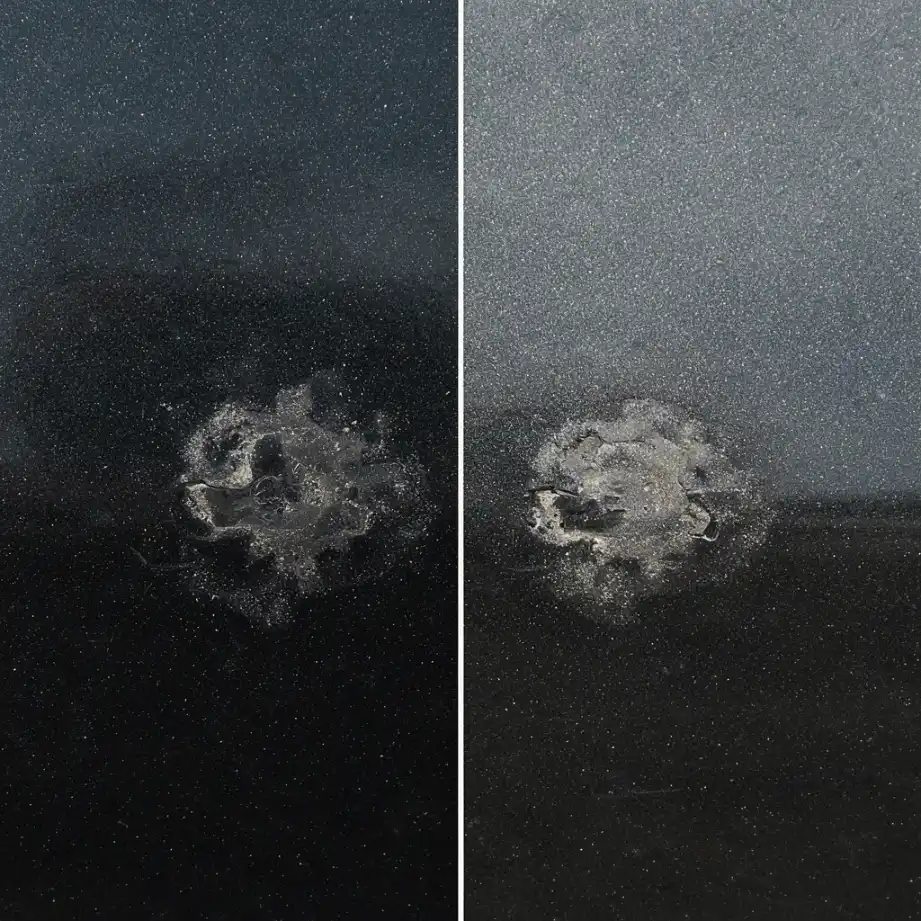
Once this distinction is clear, the decision framework becomes logical: if your primary concern is stone chips and road debris damage, PPF is what you need. If your primary concern is UV fading, chemical contamination, bird dropping damage, and easy maintenance, ceramic coating is what you need. If both are concerns — true for most Adelaide drivers who intend to keep their vehicle in excellent condition for 5+ years — the combination of both provides comprehensive protection.
Q: What is the difference between PPF and ceramic coating?
A: PPF (paint protection film) is a physical barrier, a 150-250 micron thermoplastic urethane film that absorbs stone chips and road debris impacts before they reach the paint. Ceramic coating is a chemical bond, a liquid polymer that cures to 9H hardness on the clear coat surface and protects against UV, bird droppings, chemical contamination, and minor abrasion. PPF prevents stone chip damage; ceramic coating cannot. Ceramic coating provides superior UV protection and hydrophobic water-beading performance; PPF does not match this. They protect against different threats and work best when combined. Tint Bros Adelaide installed both at Enfield, Somerton Park, and Elizabeth South.
Head-to-Head Comparison: PPF vs Ceramic Coating
Every attribute compared side by side, with a clear winner for each.
| Attribute | PPF | Ceramic Coating | Winner |
|---|---|---|---|
| Stone chip protection | Absorbs stone chips completely — the primary function | Does not prevent stone chips — paint still damaged on impact | PPF |
| UV protection | Yes, secondary benefit of the film layer | Yes, primary benefit, blocks 99% UV | Ceramic |
| Bird dropping resistance | Good — chemical resistance of TPU topcoat | Excellent — stronger chemical resistance | Ceramic |
| Water beading / hydrophobic | Moderate | Excellent — 110°+ contact angle | Ceramic |
| Self-healing | Yes — topcoat heals minor swirl marks with heat | No | PPF |
| Gloss enhancement | Moderate | Significant — deepens and amplifies gloss | Ceramic |
| Longevity | 5-10 years (professional grade) | 2-5+ years depending on tier | PPF |
| Removability | Yes — clean removal without paint damage | Semi-permanent — only worn away | PPF |
| Starting cost at Tint Bros Adelaide | $350 (bonnet) to $8,000+ (full vehicle) | $499 to $1,599+ depending on tier | Ceramic |
What PPF Does That Ceramic Coating Cannot
Adelaide's highway network creates a high stone chip environment for commuters. The South Eastern Freeway, Port Wakefield Road, the Southern Expressway, Main North Road through Enfield, and the arterial roads feeding the growth corridors of Elizabeth, Munno Para, and Salisbury all generate stone chip exposure that accumulates on the bonnet, bumper, and front guards of every vehicle driven regularly. After 2-3 years of Adelaide highway driving, a bonnet without paint protection film typically shows dozens of stone chip impacts — ranging from tiny paint chips to impacts that have reached bare metal.
Ceramic coating does nothing to prevent any of these chips. PPF prevents all of them on the panels it covers. PPF's elastomeric topcoat also heals minor surface scratches with heat from Adelaide's sun, warm water, or a heat gun — a self-healing property with no equivalent in ceramic coating. And because PPF can be cleanly removed without damaging the paint beneath, it remains the only fully reversible protection option: if you sell the vehicle or want a section replaced after a heavy impact, PPF can be peeled off and new film applied.
What Ceramic Coating Does That PPF Cannot
Full vehicle PPF at Tint Bros Adelaide starts from $4,500 for a standard sedan. Full vehicle ceramic coating starts from $499. For Adelaide drivers who want protection across every panel, not just the front impact zones, ceramic coating delivers whole-vehicle coverage at a fraction of the PPF cost — every panel, including the doors, roof, pillars, and rear, benefits from UV protection, chemical resistance, and hydrophobic performance.
Ceramic coating's 110°+ water contact angle means water sheets off the surface carrying contamination with it, cutting most owners' wash time by 30-50%. Adelaide's UV radiation is among the most intense in Australia from October through April, and UV oxidation is the primary cause of clear coat degradation over the life of a vehicle — ceramic coating applied to every panel provides uniform UV protection the whole vehicle. In Adelaide's summer, where temperatures regularly exceed 35°C, bird droppings can etch unprotected clear coats within 30 minutes; ceramic coating's chemical resistance extends this window significantly.
Q: Is PPF better than ceramic coating?
A: Neither is universally better — they protect against different threats. PPF is the only product that prevents stone chip damage and has a self-healing topcoat. Ceramic coating provides superior UV protection, hydrophobic performance, chemical resistance, and whole-vehicle coverage at a lower cost entry point. For Adelaide drivers primarily concerned about stone chips from highway driving, PPF on front impact zones is the right choice. For drivers primarily concerned about UV, bird dropping damage, and easy maintenance across the whole vehicle, ceramic coating is more appropriate. Most Tint Bros Adelaide customers who want comprehensive protection choose a combination of both.
Which One Should You Choose? A Decision Framework for Adelaide Drivers
Choose PPFif you drive regularly on Adelaide's highways and have noticed stone chips accumulating, you have a new car and want to protect the factory paint from day one, you own a prestige vehicle where stone chip repair costs are disproportionately expensive, or you want a physically reversible protection option.
Choose ceramic coatingif your vehicle is garaged or parked on covered suburban streets with lower stone chip exposure, your primary concern is UV fading, bird dropping damage, and swirl marks from washing, you want whole-vehicle protection at a single appointment, or you drive in Adelaide's coastal suburbs such as Somerton Park, Glenelg, or Brighton where salt air is a surface contamination concern.
Choose bothif you are buying a new vehicle and want comprehensive protection from day one, you own a prestige or performance vehicle, you drive Adelaide highways and park outdoors in Adelaide's UV conditions, or you want the peace of mind of physical and chemical protection at once. Tint Bros Adelaide regularly completes combined PPF + ceramic coating installations in a single appointment.
Q: Should I get PPF or ceramic coating in Adelaide?
A: For most Adelaide daily drivers on a budget, ceramic coating provides the best return: whole-vehicle UV, chemical, and hydrophobic protection starting from $499. For Adelaide highway commuters or new car buyers who want to prevent stone chips on the bonnet and front end, PPF is essential — ceramic coating alone will not prevent chip damage. For comprehensive protection, the combination of PPF on high-impact zones (bonnet, bumper, guards) and ceramic coating over the entire vehicle — including over the PPF panels — addresses every realistic threat to an Adelaide vehicle's paint.
PPF + Ceramic Coating Combined: How It Works at Tint Bros Adelaide
The combination of PPF on high-impact zones and ceramic coating applied over the entire vehicle, including the PPF panels, is the most comprehensive paint protection available and the approach Tint Bros recommends for new car buyers and prestige vehicle owners in Adelaide.
PPF is installed first, applied to the bonnet, front bumper, front guards, mirrors, and any other zones selected, and the film is cured and settled. Ceramic coating is applied second, over the entire vehicle including over the PPF panels, bonding to both the PPF surface and the unfilmed paint and creating a consistent hydrophobic, UV-resistant surface across every panel. PPF handles stone chips and physical impacts on the front end; ceramic coating handles UV, bird droppings, chemical contamination, and surface contamination across the entire vehicle. Booking both at a single Tint Bros Adelaide appointment is more efficient than scheduling them separately, and Tint Bros can sequence the installation correctly to achieve the best result from both products. Adding tint as well? See whether to tint before or after ceramic coating.
PPF starting prices: bonnet from $350, front package from $800, full vehicle from $4,500. Ceramic coating starting prices: Essential Protect (2-year warranty) from $499, Advanced Shield (3-4 year warranty) from $699, Ultimate Defence (5+ year warranty) from $999. Combined packages: free consultation to determine the right combination for your vehicle. Phone (08) 7006 0841. ZipPay available.
Cost Comparison: PPF vs Ceramic Coating at Tint Bros Adelaide
| Protection Option | What It Covers | Starting Price |
|---|---|---|
| Ceramic coating — Essential Protect | Full vehicle, 2-year warranty | From $499 |
| Ceramic coating — Advanced Shield | Full vehicle, 3-4 year warranty | From $699 |
| Ceramic coating — Ultimate Defence | Full vehicle, 5+ year warranty | From $999 |
| PPF bonnet only | Bonnet panel | From $350 |
| PPF front package (partial) | Bonnet, bumper, mirrors, partial guards | From $800 |
| PPF front package (full) | Full bonnet, bumper, guards, mirrors | From $1,200 |
| PPF full vehicle | Every painted panel | From $4,500 |
| PPF front package + ceramic (combined) | PPF front zones + ceramic whole vehicle | From $1,300 |
| PPF full vehicle + ceramic (combined) | Full vehicle PPF + ceramic over all panels | From $5,000 |
All prices are starting prices and vary by vehicle make, model, size, and paint condition. Contact Tint Bros at (08) 7006 0841 or tintbros.com.au/getquote for a vehicle-specific quote. See our paint protection film prices Adelaide guide, our 2026 PPF cost Adelaide breakdown for a full front-end and full vehicle PPF cost breakdown, or our ceramic coating cost Adelaide guide for coating pricing by tier and vehicle size.
Not sure which protection is right for your car? Compare the full technical breakdown of each product in our ceramic coating Adelaide guide and our paint protection film Adelaide guide, or see our ceramic coating prices Adelaide guide for package costs , or call Tint Bros on (08) 7006 0841 for a free consultation. Three Adelaide locations: Enfield, Somerton Park, and Elizabeth South.
Tint Bros Adelaide installs paint protection film (PPF) and ceramic coating at three Adelaide locations. PPF (physical protection): prevents stone chips, 150-250 micron TPU film, self-healing topcoat, 5-10 year warranty, from $350 (bonnet) to $8,000+ (full vehicle). Ceramic coating (chemical protection): 9H hardness, UV resistance, hydrophobic surface, from $499 (Essential 2yr) to $1,599+ (Ultimate Defence 5yr+). Combined PPF + ceramic coating: PPF installed first on impact zones, ceramic coating applied over the entire vehicle including PPF panels. Enfield (08) 7006 0841, Somerton Park (08) 7001 6655, Elizabeth South 0401 580 022. tintbros.com.au. ZipPay available. Additional Tint Bros services include window tinting, house/office tinting, and automotive electrical work. Established 2020. 5.0 stars. For the full picture on ceramic durability by tier, read how long ceramic coating lasts in Adelaide. Quick answers on coating are in our ceramic coating questions Adelaide. For how coatings work at the particle level, see nano ceramic coating explained.
Not sure which protection is right for your car? Call Tint Bros on (08) 7006 0841 or book a free consultation. Our team assesses your vehicle, driving pattern, and budget to recommend the right protection — or combination. ZipPay available.
Get a Free QuoteFrequently Asked Questions: PPF vs Ceramic Coating Adelaide
Straight answers to the questions Adelaide car owners ask most before choosing paint protection.
Can you apply ceramic coating over PPF?
Yes — and this is actually the recommended approach for the combined installation at Tint Bros Adelaide. Ceramic coating is applied after PPF installation, covering the entire vehicle including the PPF panels. The ceramic coating bonds to the PPF surface and enhances its hydrophobic performance and UV resistance. The result is PPF's physical chip protection combined with ceramic coating's hydrophobic, UV-resistant, and easy-clean surface properties on every panel.
Does PPF replace the need for ceramic coating?
No. PPF and ceramic coating address different threats. PPF prevents physical impacts (stone chips, road debris) on the panels it covers. It does not provide the hydrophobic water-beading performance, UV protection for unfilmed panels, or chemical resistance of quality ceramic coating. A vehicle with PPF on the front panels still benefits from ceramic coating on the remaining panels for UV, contamination, and maintenance reasons. Most Tint Bros Adelaide customers who invest in PPF also apply ceramic coating over the entire vehicle.
Which is more expensive — PPF or ceramic coating in Adelaide?
PPF is generally more expensive than ceramic coating for equivalent coverage. Full vehicle ceramic coating at Tint Bros Adelaide starts from $499. Full vehicle PPF starts from $4,500. However, they are not equivalent products — PPF provides physical impact protection that ceramic coating cannot, which justifies the price difference for drivers with stone chip concerns. Partial PPF (front package from $800) combined with ceramic coating is a cost-effective way to address both stone chips and chemical/UV protection.
How long do PPF and ceramic coating last in Adelaide?
Professional-grade PPF from Tint Bros Adelaide carries a 5-10 year manufacturer warranty. Ceramic coating warranties range from 2 years (Essential Protect) to 5+ years (Ultimate Defence). In Adelaide's conditions — high UV intensity, moderate dust, coastal salt in some suburbs — ceramic coating at the lower warranty tiers may show degradation closer to the lower end of the range on perpetually outdoor vehicles. PPF's physical thickness makes it more robust against environmental degradation. Both products last significantly longer with correct maintenance.
Where can I get both PPF and ceramic coating installed in Adelaide?
Tint Bros installs both PPF and ceramic coating at three Adelaide locations and regularly completes combined installations in a single appointment: 377 Main North Road Enfield SA 5085 (08) 7006 0841; 1A Paringa Ave Somerton Park SA 5044 (08) 7001 6655; 6 Trimmer Road Elizabeth South SA 0401 580 022. Book a free consultation at tintbros.com.au/getquote to discuss the right combination for your vehicle and budget. ZipPay available.
Still have questions? Contact us directly